So I'm back. Japan was exactly the reset I said it would be — three weeks of walking everywhere, eating well without thinking about it, and not touching a barbell once. No guilt, no "travel workout," no checking in on a programme that was perfectly happy looking after itself. By the end I was genuinely itching to train again, which is the whole point of a deload.
This week I picked it back up. First session in three weeks. And I'll be honest — it went better than I expected.
The comeback session
Same as ever: the six exercises, twice a week. I didn't try to make up for lost time. No ego loads, no chasing the numbers I left off at. I went in, warmed up properly, and ran the session at something like 80–90% of where I'd been. That's the rule after time off — you ease back in, you don't try to prove a point in the first ten minutes.
And here's the thing nobody tells you: after a real break, the first session feels good. The fatigue I'd been quietly carrying for months was gone. The weights moved cleanly. Two weeks off didn't set me back — it cleared the decks. That's the deload doing its job, exactly as advertised.
The new toy
Now for the part I'm actually excited about. While I was away I built my own training app. I'm a UI developer by trade, so this has been brewing for a while — every tracking app I've tried is either bloated with features I'll never use, or it's hiding the one number I actually care about behind a subscription.
So I built my own. It's called Chi, and I used my first session back as its first real test.
Chi is a wellness tool, not a medical device. The scores describe trends in activity and recovery — they're not intended to diagnose, treat, or monitor any condition. This post is general education, not medical advice. Read the full disclaimer.
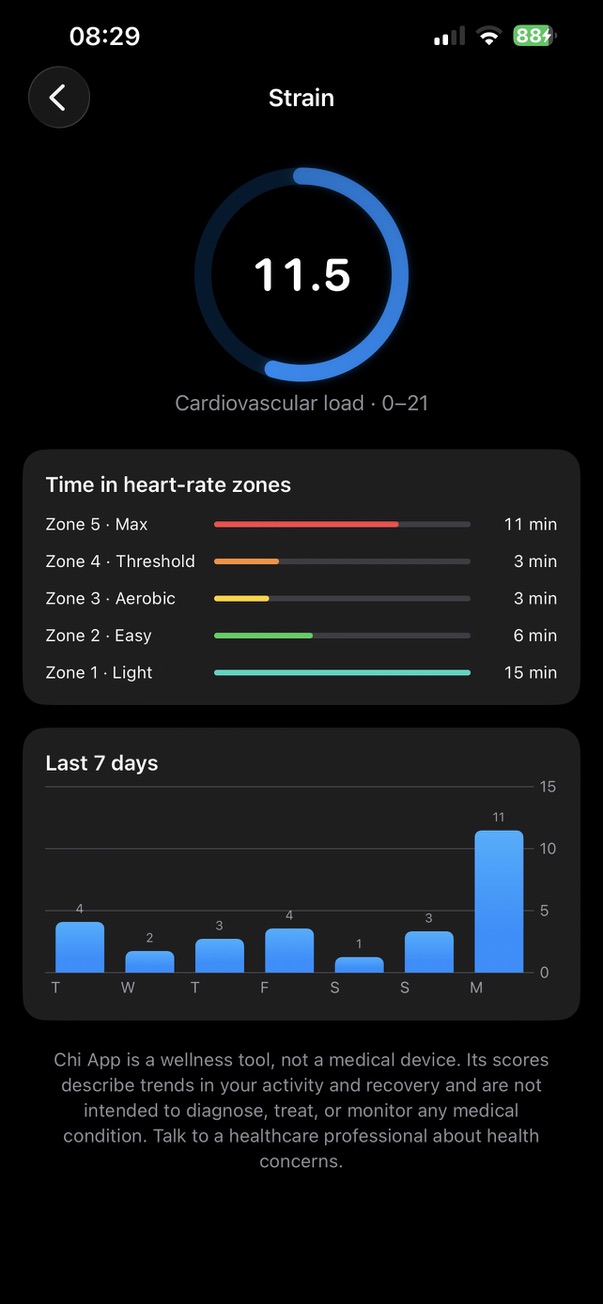
The screen above is the bit I'm most pleased with. It takes the session and boils it down to a single strain number — a cardiovascular load score on a 0–21 scale. One glance and I know how hard the session actually was, rather than guessing from how sweaty I felt.
Underneath that it breaks the time down by heart-rate zone:
- Zone 5 · Max — 11 min
- Zone 4 · Threshold — 3 min
- Zone 3 · Aerobic — 3 min
- Zone 2 · Easy — 6 min
- Zone 1 · Light — 15 min
That's a strength session, not a cardio one — most of the work sits in the light and max zones, with the spikes coming from the heavy sets and the easy stretches being the rest between them. Seeing it laid out like that is genuinely useful. It tells me the session was honest without being reckless.
The last 7 days chart at the bottom tells the real story, though. Look at it: a string of little bars — those are the Japan days, all that incidental walking ticking over at a 1 to 4 — and then one big spike of 11 where I came back and actually trained. That's a deload and a comeback drawn out as a bar chart. I couldn't have illustrated the last three weeks better if I'd tried.
Why build it at all
The honest answer is that it scratches two itches at once. I get to write code, which I enjoy, and I get a tool that does exactly what I want and nothing more. The whole philosophy of this site is maximum gains, minimum effort — strip everything back to what actually moves the needle. An app that surfaces one clear number and gets out of the way fits that perfectly.
It's early days. Right now it does strain and heart-rate zones; recovery and a proper session log are next on the list. I'll keep writing about it as it grows — partly to keep myself honest, partly because building it has been as enjoyable as the training itself.
For now: deload done, first session in the bank, and a new app to make sense of it. Good to be back.
— Johnny